.svg)


.svg)


What is a multi-agent system?
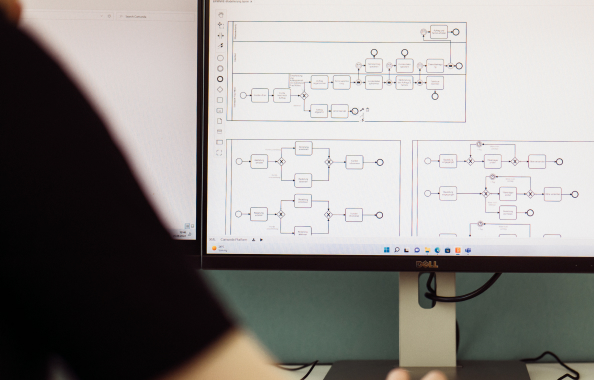
A multi-agent system (MAS) is an AI system in which multiple specialized AI agents work together in a coordinated manner to solve a common task. Each agent has a clearly defined role, its own tools, and limited responsibility.
Unlike a single agent, which plans and executes all steps on its own, a multi-agent system distributes the work: planners break down tasks, researchers gather information, verifiers validate results, and executors act within systems.
Multi-agent systems are the logical extension of the “Agentic AI” concept: Instead of making a single agent increasingly complex, multiple focused agents work together—each with a clear task and a limited context window.
MAS are of interest to small and medium-sized businesses when processes are complex and consist of many sub-steps—for example, in procurement, in preparing quotes, or in customer service ticket workflows. Where a single agent would be overwhelmed, an MAS delivers clear results.
Best Practices for Multi-Agent Systems
In productive MAS projects, these six principles make all the difference:
- Clear Roles: Each agent has a clearly defined purpose—not a “jack-of-all-trades,” but a specialist.
- Small Context Windows: Specialists need less context—this saves tokens and improves quality.
- Clean contract design: How do agents communicate? What formats and conventions are used?
- Incorporate a validator: A separate validation agent significantly improves quality and security.
- System-Level Guardrails: Not just per agent—the entire system also needs boundaries and kill switches.
- Monitoring & Logs: Every agent step should be loggable—essential for debugging, auditing, and iteration.

Common Mistakes in Multi-Agent Systems
These pitfalls are particularly common in MAS projects:
- Too many agents: A MAS with 15 agents and no clear purpose is chaos, not a system.
- Unclear Responsibilities: When two agents share the same task, neither does it correctly.
- No validator: Without a validation agent, errors propagate through all layers all the way to the user.
- Costs skyrocket: Multiple agents make more LLM calls—without budget limits, this gets expensive.
- No kill switch: When agents chase each other in infinite loops, an emergency shutdown is needed.
Multi-Agent vs. Single-Agent vs. Workflow
Three architectures that are often considered as alternatives—each with clear strengths:
- Workflow (classic): Fixed rules and sequences. Fast, clear, but inflexible for unstructured tasks.
- Single-Agent: A single AI agent plans and acts—ideal for well-defined, moderately complex tasks.
- Multi-agent system: Multiple specialized agents—ideal for complex, multi-step processes requiring different skill sets.


Multi-Agent Systems for Your Processes
In a free initial consultation, we’ll take a look at your complex processes and identify where a multi-agent system can have the greatest impact—including a concrete implementation proposal.
As an AI partner for small and medium-sized businesses, we take MAS from prototype to production—with clear governance, monitoring, and business value.
What We Offer
- AI agents for businesses —foundation and expansion within multi-agent architectures.
- Agentic AI Use Case — Reference project and detailed approach.
- AI Integration —Integrating MAS into your CRM, ERP, and DMS landscapes.
- AI Agent in the Glossary — the foundation upon which multi-agent systems are built.