10 min read

Choosing the Right AI Model for Software Development: Why Code Review Is the Best Practical Test

Choosing the Right AI Model for Software Development: Code Review as Practical Test | prodot
19:15

A model can sound confident and still be wrong about the code in front of it. In code review, that usually shows up quickly: valid syntax is flagged as non-compiling, a modern language feature is treated as a bug, or the model produces a finding that looks plausible but does not exist in the code. For development teams, this is not a cosmetic problem. It directly affects generated code, refactorings, tests, documentation, and review quality.

When AI Writes Code, It Has to Understand Code

Tools such as GitHub Copilot, Cursor, Claude Code, or internal assistants make AI usable inside the development workflow. They add repository context, IDE integration, tool access, file editing, and agentic workflows. But the core reasoning still comes from the model underneath. In most cases, that model is a large language model, or LLM, which consumes prompts, source code, repository context, and tool output, then produces a suggestion, review comment, explanation, or code change.

From a machine learning perspective, model differences are expected. Training data, training cutoff, optimization target, and specialization all matter. A model optimized for helpful chat behavior through instruction tuning or RLHF can behave differently from a model tuned more aggressively for coding tasks. A model trained before a language feature became common may treat that feature as distribution shift: the syntax is valid, but it is outside the patterns the model learned reliably. In other words, newer language features or uncommon code structures can become out-of-distribution territory.

That is why code review is such a useful warning signal. If a model hallucinates findings, misreads compiler-level semantics, or confuses valid construct usage with an error, it is not just missing a detail. Its learned representation of code behavior does not align well enough with the ground truth of the language, runtime, or framework. The question is therefore no longer only: should we use AI in software development? The better question is: which model actually understands our stack, our codebase, and our quality requirements?

Not Every Model Fits Every Project

Choosing an AI model is both a technical and an economic decision. Two models can run inside the same tool, receive the same prompt, and still produce very different results. A public leaderboard score is useful, but it is not the whole story. Public benchmarks usually test defined tasks on public datasets. A real codebase can look very different: legacy patterns, internal frameworks, niche libraries, mixed language versions, and recurring project-specific defect patterns.

In practice, model selection is a trade-off between several criteria:

  • Quality: Does the model find real problems without inventing new ones? In evaluation terms: precision (avoiding false findings) and recall (catching real problems).
  • Cost: What are the token costs, runtime costs, and integration costs? A larger context window (how much code and surrounding information the model can process at once) can help with bigger repositories, but it also means more processed tokens, higher cost, and sometimes higher latency (slower responses).
  • Data sovereignty: Can source code, architecture details, and confidential project context be sent to an external service? This is about control over where data is processed, stored, logged, and potentially reused.
  • Operating model: Is a cloud model acceptable, or do regional deployment, private cloud, or on-premises hosting matter? Open-weight models (models whose weights can be downloaded or hosted independently) can be attractive when code and context must stay inside a controlled environment.

The newest large proprietary frontier models (current top-tier models from major providers) often deliver very strong results and require little deployment effort. Cheaper cloud models, regionally hosted models, or locally operated open-weight models can be a better fit when governance, auditability, or regulatory constraints matter more than maximum raw capability.

The decision also does not have to be the same for every workflow. Critical code reviews, architecture questions, or complex refactorings may justify a stronger and more expensive model. Routine documentation, simple tests, or lower-risk assistance may be handled well enough by a cheaper or self-hosted model. In the end, the best choice is not simply the strongest model, but the model with the right balance of quality, cost, latency, data sovereignty, and operating model for the task.

Why Code Review Is a Strong Practical Test

Code review is a core part of professional software development. The reason is simple: humans miss things. Even experienced developers can overlook bugs when logic, side effects, edge cases, or requirements span multiple files.

A good code review is not only a formatting check. It is about code quality, early detection of bugs, logic errors, risky API usage, and deviations from requirements. It also has a learning effect: good reviews make visible why a solution is robust or where it may create problems later.

This is where AI can be useful. The more relationships need to be checked, the more likely a human reviewer is to miss something. A model can provide an additional perspective, compare patterns, and inspect larger contexts systematically. At the same time, models introduce their own failure mode: false positives. They can claim problems that do not exist or misclassify valid language constructs as invalid.

That makes code review especially useful for model evaluation. Code generation is hard to score objectively because many solutions can be acceptable. A prepared review task is closer to an exam: the model must find defined problems, avoid invented findings, and support its claims with code evidence. A model that can review code reliably demonstrates a working understanding of syntax, semantics, and behavior. That same understanding is the foundation for better code generation, refactoring, and documentation.

How to Prepare Tests for AI Models

Because models have different strengths, tests should not be too generic. It is better to focus the review on concrete topics: the technologies in use, frameworks, architecture patterns, libraries, or language versions. Since .NET and C# are central in our environment, we prepared a small eval harness: a repeatable benchmark setup with fixed inputs, fixed prompts, fixed scope, and rubric-based scoring.

The key is evaluation design. Every model receives the same code, the same prompt, the same scope, and the same output format. The answers are then evaluated against the same prepared ground truth and scoring system. This makes model differences attributable to model behavior, not to prompt drift or changing test conditions.

A good test prompt should define at least:

  • Review focus: Which classes of problems should be evaluated?
  • Scope and out of scope: What counts as a finding and what intentionally does not?
  • Assumptions and context: Which unusual but valid constructs should be tolerated, especially where models may otherwise produce false positives?
  • Output format: How must the model answer so the result can be scored consistently?

In our tests, each answer had two sections:

  • Important Issues: bugs, logic errors, risky API usage, or contract problems, each with a code reference.
  • Features Used: language features from the target version that actually appear in the code, again with a code reference.

Each test also needs an appropriate code sample. The code should stay within the chosen focus area, compiled successfully, and contain deliberately planted issues. This is like fault injection: known defects are seeded into the code to measure whether the reviewer detects them. In the C# tests, each sample used as many features as possible from the target language version but did not use newer syntax.

The code samples were custom-built rather than copied from public examples. This matters because LLM benchmarks can suffer from train-test leakage, where a model performs well because similar material was present in training data. Custom samples reduce that risk and make the result more about code understanding than memorization.

The final piece is scoring. For each test, a ground truth is prepared up front. Instead of a relative 0-to-10 impression, concrete points are assigned:

  • points for expected issues and expected features
  • bonus points for evidence quality, for example complete code references
  • penalties for false positives, false compile claims, noise, or irrelevant performance commentary

This scoring design gives us a measurable evaluation: what was found correctly, what was missing, and where the model made unsupported claims. In evaluation terms, it helps compare recall (catching real problems) and precision (avoiding false findings) across models and language-version tests.

What the Tests Reveal About AI Code Understanding

After scoring the results, we saw what developers know from human reviews as well: visible things are easier to catch than hidden relationships. Many models recognized modern syntax, obvious constructs, and clear risks. The harder cases appeared where the model needed semantic understanding: not just what the code says, but how the code behaves.

In precision and recall terms, the pattern was clear. Models tended to perform better on syntax-level findings and visible constructs, while recall dropped on behavior-level issues: real problems were missed when they depended on runtime behavior, edge cases, culture-sensitive behavior, nullability, deferred execution, or subtle language rules.

Some failures were especially telling. Deferred execution, for example, requires the model to reason about when code runs, not just where it appears. Culture-sensitive behavior requires more than recognizing a string API call; the model must understand how runtime environment and locale can change the result. These are the same places where human reviewers slow down or run the code before making a strong claim.

False positives were also visible. Some models missed real issues and invented additional ones: alleged compiler errors, incorrect runtime assumptions, or criticism of valid but uncommon language features. For code review, both error types matter: false negatives leave real problems in the code, while false positives create unnecessary review work and reduce trust in the model output.

This is why code review is such a useful test. A good model cannot merely find something. It must find the right things, avoid unsupported claims, and cite the code. That is the same capability development teams need later for code generation, refactoring, and documentation.

What the Benchmark Shows

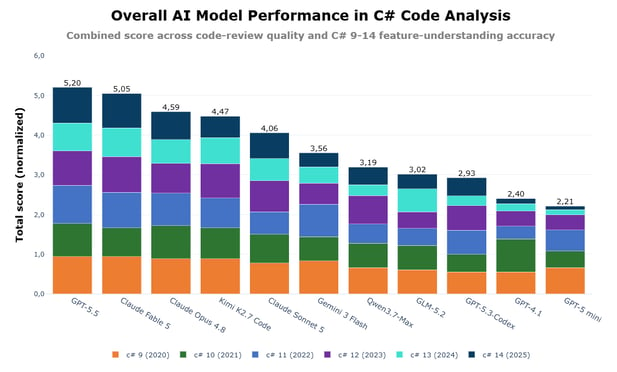
Some results were expected, others were more interesting. Expected: the newest large frontier models are usually strong in C# code review. More interesting: even among the current top models, the differences are measurable. In our benchmark, GPT-5.5 remained the strongest reference across all tested models.

Chart1_EN

Figure 1: Overall AI Model Performance in C# Code Analysis

One bar represents one AI model. The colored segments represent normalized scores for C# 9 through C# 14. Each version contributes at most 1 point, so the maximum total score is 6. The score combines code-review quality and feature-understanding accuracy. Normalization makes tests with different point budgets comparable.

The comparison included proprietary frontier models, models available in GitHub Copilot, current coding models, and open-weight models. For interpretation, the most relevant groups are the leading cluster and the models that were expected to be strong but did not reach that cluster.

Claude Fable 5 landed very close to the top, confirming that Anthropic is strong in coding-related tasks. Still, it did not beat GPT-5.5 in the overall result. Kimi K2.7 Code was the positive surprise: as an open-weight, coding-focused model, it scored above Claude Sonnet 5 and ahead of both the proprietary Qwen3.7-Max and the open-weight GLM-5.2 in this C# benchmark.

That result is worth calling out because model reputation did not map cleanly to our C# code-review results. GLM-5.2 and Qwen3.7-Max are both positioned as capable models for long-context or agentic software work. In our test setup, however, Kimi K2.7 Code performed better. The explanation is not that one model is always better. The better explanation is: coding benchmarks are workload-specific. A model that is strong in general coding or agentic tasks is not automatically the strongest reviewer for modern C# language semantics.

Other tested models were clearly behind the leading group in this benchmark. For practical use, the lesson is simple: it is not enough for a model to look strong in general. It must understand the concrete stack reliably. That is where the strongest models separate themselves: not through one impressive answer, but through stable performance across multiple language versions.

Model Performance Is Version-Dependent

Chart2_EN

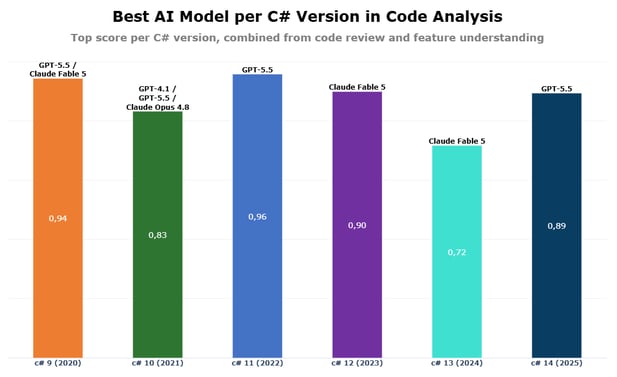
Figure 2: Best AI Model per C# Version

The overall score does not tell the full story. The same model is not always leading in every C# version. GPT-5.5 remains very stable, while Claude Fable 5 achieves the best score in C# 12 and C# 13. This matters in real projects because codebases rarely contain only one generation of language features. Old patterns and modern constructs often live side by side.

Balance Matters: Review Quality vs. Feature Understanding

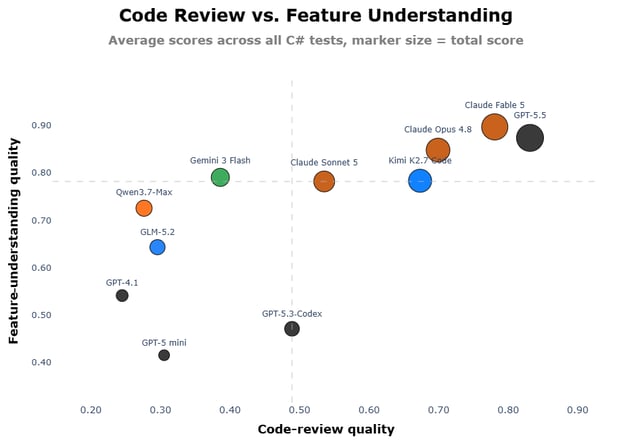
The quadrant view is the most revealing look at the results. The overall score shows who is strong. This view shows why: does the model find real problems in the code, and does it also understand the language features being used?

Chart3_EN

Figure 3: Code Review vs. Feature Understanding

The two axes represent different capability dimensions. Code-review quality reflects the precision and recall balance from our scoring: finding real problems while avoiding false findings. Feature understanding reflects whether the model reliably recognizes the language-version features used in the code.

The dashed lines represent the average across all tested models. The upper-right area is therefore the most attractive quadrant: models there score above average in both dimensions. This is where the leading group appears: GPT-5.5, Claude Fable 5, Claude Opus 4.8, and Kimi K2.7 Code.

This is also why single-number leaderboards can be misleading. A model can look strong in aggregate but still be lopsided: good at spotting issues, but weaker with modern syntax; or good at naming features, but less reliable when reasoning about behavior. For code-assistance workflows, that imbalance becomes a practical risk.

Kimi K2.7 Code stands out again because it is not only high in the ranking but also balanced. A model that is above average on both axes is lower risk across a wider range of coding tasks. That makes Kimi especially relevant when model choice is not only about maximum quality, but also about deployment options, hosting model, and data sovereignty.

For model comparisons, this balance is important. A single score is rarely enough. Depending on the use case, it can make sense to compare code-review quality, language-feature understanding, cost, token usage, and operating model separately. Only then does the decision become useful for an actual development process.

What We Learned from the Comparison

The first lesson is simple: AI tool and AI model are not the same thing. Claude Code, GitHub Copilot, Cursor, and similar coding tools extend an underlying model with project context, codebase access, tool integration, file editing, code changes, and agent workflows. The quality of the actual code analysis still depends heavily on the selected model.

Several practical lessons follow:

  • Model selection is not a side topic. For coding, review, refactoring, and documentation, the selected model strongly influences reliability.
  • Public benchmarks are not enough. A model can look strong on leaderboards but underperform in a specific codebase because the task distribution is different: other language versions, internal frameworks, legacy patterns, and project-specific defect types.
  • Code review is a practical benchmark. Review output can be checked against ground truth: Did the model find expected issues? Did it avoid false findings? Did it recognize the correct language features? That makes code review much easier to evaluate than open-ended code generation.
  • Ground truth turns opinion into measurement. Without predefined expected results, a comparison stays subjective. With ground truth, normalized scores, and penalties, we can evaluate precision (avoiding false findings) and recall (catching real problems) instead of relying on impressions.
  • One score is rarely enough. Overall score is useful, but it hides important differences. For model selection, it helps to compare version-level performance, code-review quality, feature understanding, and later also price-performance, token usage, latency, and operating model.

The goal is not to find one model for everything. Often a mix is better: a strong model for critical reviews and complex refactorings, a cheaper or self-hosted model for routine tasks. The important part is the method: build repeatable code-review tests for your own stack, score them against ground truth, and rerun them when new models appear.

Conclusion: The Right Model Decides the Quality

AI assistance in software development stands or falls with the code understanding of the selected model. If a model does not reliably understand modern language features, semantics, or recurring defect patterns in the stack, the impact shows up directly in reviews, refactorings, documentation, and generated code.

Our benchmark showed this clearly: the leading models were not just strong in aggregate. They were more stable across C# versions and better balanced between code-review quality and feature understanding. At the same time, some models that looked strong in general coding contexts struggled with specific C# semantics, false positives, or missed behavior-level issues.

The main lesson is simple: model choice should be measured, not guessed. Well-prepared code-review tests with seeded defects, ground truth, and precision and recall aware scoring show which model actually works for a specific stack.

Because the model landscape changes quickly, these tests should become reusable evaluation infrastructure. Every new model generation can then be tested again: not against abstract claims, but against the code, language versions, and risks that matter in real projects.


Sie haben Fragen?
Wir helfen Ihnen gerne weiter.

Not obvious, but noticeable: Anomaly detection in the vehicle fleet

1 min read

Not obvious, but noticeable: Anomaly detection in the vehicle fleet

Thousands of journeys are recorded every day. GPS data, tire pressure, fuel consumption, engine speed - every journey leaves a digital fingerprint....

Read More
AI in Retail: More Than Just a Pilot Project

1 min read

AI in Retail: More Than Just a Pilot Project

Nine out of ten retailers worldwide are already testing or using AI - but only five percent are achieving a clearly measurable ROI. The gap between...

Read More
Why do so many AI projects fail in small and medium-sized businesses?

1 min read

Why do so many AI projects fail in small and medium-sized businesses?

95 percent of all generative AI projects do not deliver a measurable ROI. Among German small and medium-sized enterprises, only a few make the...

Read More